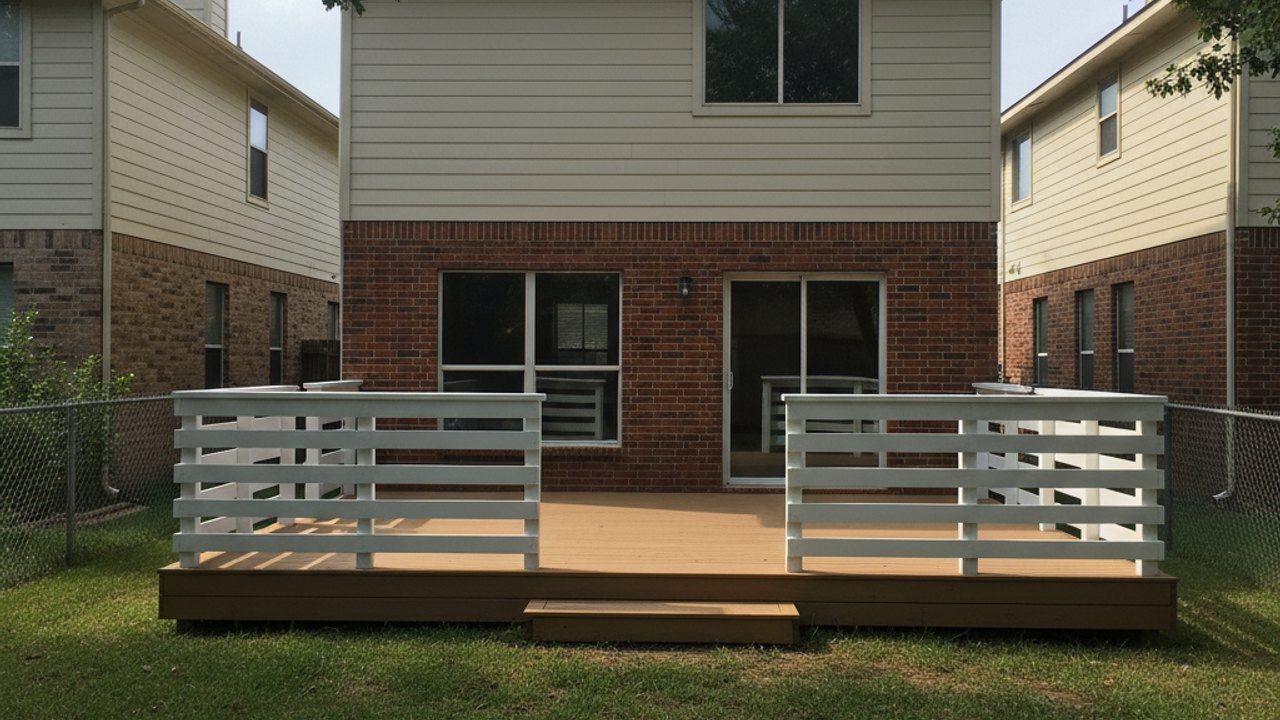
A deck is one of the few home projects where the mistakes are buried, literally, in a hole in the ground. You can't see a bad footing once the post is set and the boards are down. So the choice of builder matters more than the choice of decking material, and most homeowners spend their time on the wrong question. They ask what it costs per square foot. They should be asking what's under the surface.
Start with the ground, because Allen's clay doesn't forgive shortcuts
Most of Allen sits on Blackland Prairie clay. It swells when it's wet and shrinks hard when it's dry, and North Texas gives it plenty of both, a soggy May and a bone-dry August in the same year. A footing that's just poured into a shallow hole will heave and settle with that clay, and over a few seasons your deck starts to rack, the railing posts lean, the steps pull away from the pad. A builder who knows the area sets footings deep enough to get below the active zone where the clay moves, usually in the range of 24 to 36 inches depending on the load, with a bell-shaped bottom or a wider footprint to resist the uplift. Ask any bidder how deep their footings go and why. If the answer is a shrug, or 'we always do 12 inches,' that's a builder used to building somewhere else.
Ask too about the post spacing and beam sizing, and whether they're running the numbers or just guessing off the last job. A deck 12 feet off the ground carrying a hot tub needs a different beam than a ground-level platform off the back door. A real proposal names the lumber size, 2x10 versus 2x12, and the span.
Permits aren't optional here, and skipping them will cost you later
The City of Allen requires a permit for most deck construction, and if the deck attaches to the house, the ledger board connection gets inspected before you're allowed to close it up. There's usually a footing inspection before concrete goes in and a framing inspection before the decking goes down. A builder who tells you permits are 'a hassle' or 'not really necessary for a small deck' is telling you they either don't pull them or don't know the rule. Either way, you're the one who owns the problem when you sell the house and the buyer's inspector flags an unpermitted structure, or when your insurance company asks about it after a fall.
If your lot is in one of Allen's HOA neighborhoods, Twin Creeks, Watters Creek, Bethany Lakes, Star Creek, plenty of others, there's usually an architectural review step before the city permit even gets submitted. A builder who's worked those neighborhoods before will know the HOA wants elevation drawings and sometimes a material sample, and will build that lead time into your schedule instead of surprising you with it in week two.
Materials, and what our summers actually do to them
Allen gets stretches of 100-plus degree days most Julys and Augusts, and that heat matters for two reasons. First, pressure-treated pine will check and cup as it dries out fast in that heat, so the fasteners and hardware need to be able to move with it, not fight it. Second, if you're staining or sealing, doing it in the middle of a heat wave means the product flashes off the surface before it soaks in, and you get a coating that peels within a year instead of one that lasts three or four. A builder who schedules staining for early morning, or waits for a cooler stretch in fall, is thinking about the finished product, not just getting off your property by Friday.
Composite decking has gotten popular here for a reason, it doesn't need annual sealing and it holds up to the sun better than most wood. It's also heavier, which comes back to that footing and joist spacing question. A good builder will tell you composite generally wants joists 16 inches on center instead of 24, because the boards flex more between supports than a solid wood plank does.
Red flags that are worth walking away from
- A quote with no line item for permit fees, because that usually means there's no permit.
- A ledger board attached with nails instead of lag screws or through-bolts. This is the single most common failure point in deck collapses, and it's cheap to do right.
- No flashing between the ledger and the house siding. Skip it and you're funneling water straight into the rim joist, and you won't see the rot until the deck starts to feel spongy near the house, usually two or three years in.
- A price that's noticeably lower than three other bids for the same square footage and material. Someone's cutting footing depth, lumber grade, or fasteners to get there.
- No general liability insurance certificate they can hand you on request. In Texas a deck builder doesn't have to hold a state contractor's license, so insurance and workmanship history are most of what you have to check.
What a solid contract actually spells out
A contract worth signing names the lumber species and grade, the fastener type (hot-dipped galvanized or stainless, not standard zinc, which corrodes fast against treated lumber), the footing depth and diameter, and who's pulling the permit. It should say how many days after the final inspection you can expect before the deck's ready for furniture, and for a poured footing that's usually a week for the concrete to cure enough to load, sometimes longer if it's a cold snap. It should also spell out what happens with drainage. On a lot with clay soil and flat grading, which describes a lot of Allen backyards, water needs somewhere to go besides pooling under the deck, and a builder who's thought about that will talk about grading a slight slope away from the house or adding a gravel bed under a low deck instead of leaving it as an afterthought.
None of this needs to be complicated to explain. If a builder can walk you through their footings, their fasteners, and their permit process in five minutes without dodging the question, that's most of what you need to know. We build to that standard on every job we take in Allen and the towns around it, and you can see the kind of work we do at Oasis Deck Company.